
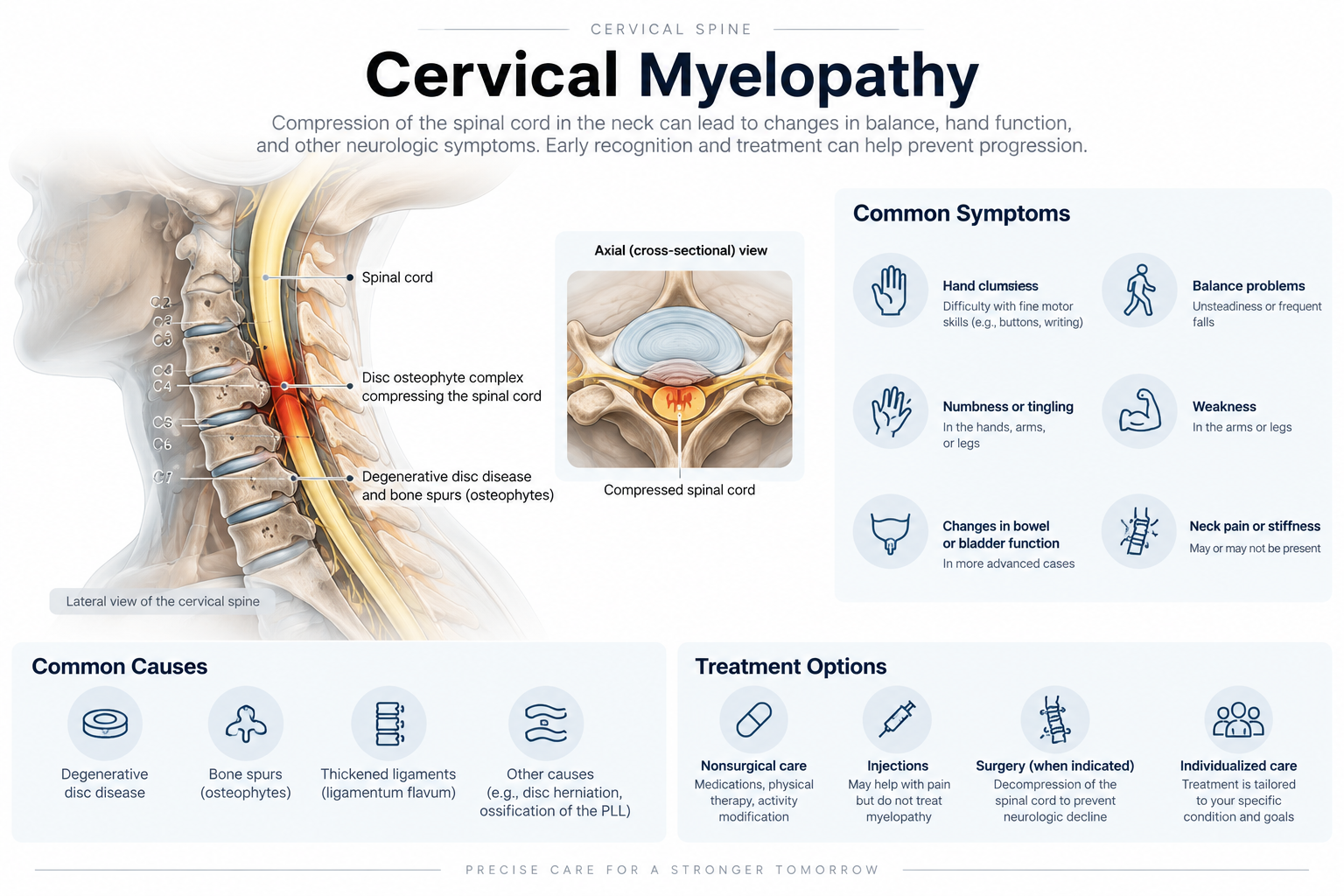
What is cervical myelopathy?
Cervical spondylotic myelopathy happens when age-related changes in the neck narrow the spinal canal and press on the spinal cord. Because the spinal cord carries signals between the brain and the rest of the body, the effects may appear in the hands, arms, balance, or legs, not only as neck pain.
Symptoms
Symptoms often develop gradually. They may include:
- Loss of hand coordination, such as trouble buttoning a shirt or writing
- Numbness, tingling, or weakness in the hands and arms
- Unsteadiness, frequent stumbling, or a change in walking
- A heavy or weak feeling in the legs
- Neck pain or pain that travels into an arm
Urgent
New loss of bowel or bladder control, saddle numbness, or rapidly worsening weakness requires urgent medical evaluation.
How it is diagnosed
The most important step is connecting your symptoms and examination to the imaging. An evaluation may include strength, sensation, reflex, coordination, and walking tests. MRI usually provides the clearest view of the spinal cord and areas of compression. X-rays or CT may add information about alignment, motion, or bone anatomy.
Treatment options
Treatment depends on the severity and progression of spinal cord dysfunction. Observation and nonsurgical care may help pain and function in selected mild cases, but they do not physically remove pressure from the spinal cord. Progressive neurological changes may make decompression appropriate.
Depending on alignment and the location and number of compressed levels, options may include an anterior decompression and fusion, disc replacement, posterior decompression and fusion, or cervical laminoplasty.
When to see a spine surgeon
An evaluation is appropriate when hand coordination, balance, strength, or walking is changing, or when imaging has shown spinal cord compression. Meeting a surgeon does not commit you to surgery. The goal is to understand the diagnosis, how quickly it may be changing, and which options are reasonable.